
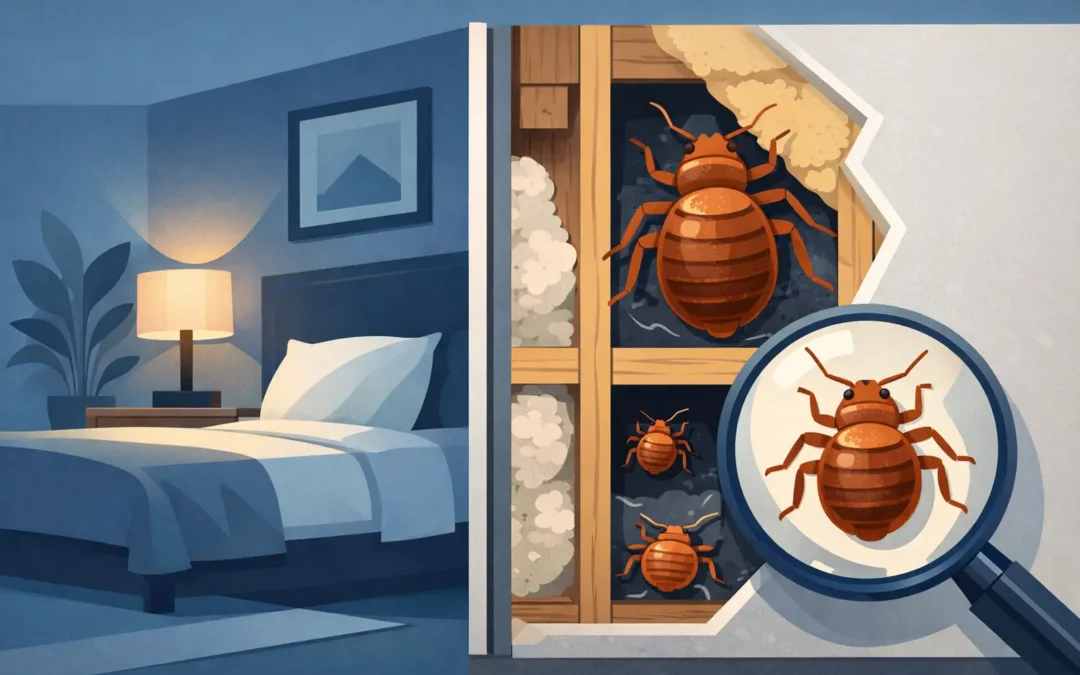
You strip the bed, check the mattress seams, and still keep getting bitten. That is usually the moment people ask the right question: can bed bugs live in walls? Yes, they can. Not the way termites live inside wood or the way ants build colonies in wall voids, but bed bugs absolutely use walls as hiding and travel areas when conditions make sense.
That matters because a lot of failed DIY treatment starts with one bad assumption – that bed bugs stay only on the bed. They prefer to stay close to a sleeping host, but when populations grow, when a room gets disturbed, or when they find protected cracks nearby, they spread outward. Walls, baseboards, outlet areas, trim gaps, and voids around pipes can all become part of the infestation.
Can bed bugs live in walls permanently?
They can hide in walls for long periods, but “live in walls” needs a little clarification. Bed bugs still need blood meals. They are not feeding on drywall, wood, insulation, or anything inside the wall itself. The wall is shelter, not food. If a host sleeps nearby, and if cracks or openings give them access, they may use those spaces repeatedly and stay there between feedings.
In real-world infestations, bed bugs often gather in the areas right around the wall rather than deep inside it. Common spots include gaps behind baseboards, under loose wallpaper, behind picture frames, around window and door trim, inside electrical outlet boxes, and where carpet meets the edge of the room. In heavier infestations, they may move farther into wall voids, especially in apartments, duplexes, and older homes with more gaps and shared structural spaces.
So yes, they can live in walls, but usually as part of a larger network of harborage sites near where people rest.
Why bed bugs move into walls
Bed bugs like tight, dark, protected spaces. A crack in the wall gives them exactly that. They are thigmotactic, which means they prefer contact on multiple sides of their body. That is why narrow seams and crevices are so attractive.
There are a few common reasons they shift from obvious furniture areas into the wall system. One is population pressure. As numbers build, the prime hiding spots fill up and bugs spread into nearby cracks. Another is disturbance. If someone sprays the bed with the wrong product, sets off a fogger, or keeps changing sleeping locations, bed bugs often scatter. They do not disappear. They relocate.
The third reason is access. Some rooms simply offer easy entry points – loose baseboards, unsealed trim, outlet gaps, plumbing penetrations, damaged drywall, and wall voids shared with neighboring units. In multi-unit housing, that last point matters a lot. Bed bugs can move from one apartment to another through openings around wiring, pipes, and wall cavities.
Signs bed bugs are hiding in walls
You usually do not catch bed bugs marching out of the drywall in broad daylight. What you see instead are clues around the edges.
Start with the baseboards and trim near the bed or couch. Look for black fecal spotting that resembles tiny ink marks, shed skins, pale eggs in protected cracks, and live bugs tucked into seams where the wall meets the floor or molding. Pay close attention behind the headboard area. Bed bugs love the protected space behind beds that sit against the wall.
Check outlet covers and switch plates carefully, but only if you can do it safely. In some cases, you may find spotting or cast skins around those openings. The same goes for curtain rods, wall-mounted decor, loose wallpaper seams, and cracks around window casings.
One pattern I tell people to watch for is this: if the bed frame and mattress show light evidence, but bites continue and nearby room edges show spotting, the infestation may be using wall-related harborages more than you think.
Are they actually inside the wall, or just around it?
Sometimes it is both. This is where people get tripped up.
If bed bugs are behind a loose baseboard or inside an outlet box, many people describe that as “in the wall.” Fair enough. From a treatment standpoint, what matters is whether they are in protected structural gaps that casual surface spraying will miss.
If they are deep in a sealed wall void with no practical access, that creates a different challenge than bugs tucked behind trim. But in many homes, the infestation is concentrated in reachable edge zones – the cracks, joints, penetrations, and void entrances connected to the wall system. Those are often the places that need the most detailed work.
What this means for treatment
If you are treating bed bugs yourself, wall harborages change the job. You cannot just wash bedding, spray the mattress, and call it done. You need a room-based plan that targets every likely harborage around where people sleep or rest.
That means inspecting the bed, frame, nightstands, upholstered furniture, baseboards, trim, cracks, and wall-adjacent hiding spots in one connected process. It also means understanding the limits of different products. Some liquid products are labeled for cracks and crevices, some dusts are useful in certain void applications, and some areas should never be treated casually or with unlabeled products.
This is where DIY often goes sideways. People either under-treat and miss the hidden sites, or they over-apply products in unsafe ways. More chemical does not mean better control. Wrong placement can scatter bugs, waste time, and create safety issues.
How to inspect wall areas the right way
Keep the process methodical. Start with the sleeping area and work outward in a slow circle. Pull the bed slightly away from the wall if needed. Remove and inspect the headboard, especially the back side and hardware joints. Examine baseboards within several feet of the bed first, then expand farther if evidence suggests spread.
Use a bright flashlight and a thin probing tool to inspect cracks, but do not start ripping walls apart unless there is a clear reason. Most infestations can be mapped through evidence at accessible edges. In many cases, removing outlet covers or disturbing fixtures is not the first move unless you know how to do it safely and legally in your setting.
Focus on where bugs can enter and exit wall voids. The entrance points often tell the story better than the void itself.
Can bed bugs spread through walls to other rooms?
Yes, especially in apartments and attached housing, but also within single-family homes. If one bedroom is heavily infested, bed bugs may move through wall voids or along baseboards into nearby rooms. They can also spread more simply by hitchhiking on laundry, clutter, furniture, or people.
That is why isolated treatment of one object rarely works. If the problem has reached wall pathways, your treatment plan has to account for adjacent furniture, room perimeter areas, and sometimes neighboring spaces. It depends on the structure and on how long the infestation has been active.
What not to do
Do not use bug bombs or total-release foggers. These products are notorious for poor bed bug control and can push bugs deeper into hiding.
Do not start spraying random household pesticides into outlets, inside walls, or across every surface in the room. Label directions matter, and electrical areas require extra caution. Also, never assume that if you cannot see bugs on the bed, the infestation is gone.
And do not keep sleeping in a different room every night. That often spreads the problem by giving bed bugs new feeding locations.
The practical fix
When bed bugs are using wall areas, the answer is not panic and it is not demolition. The answer is a complete treatment plan built around inspection, preparation, targeted applications, monitoring, and follow-up.
You need to reduce clutter, isolate and treat the bed setup correctly, address the cracks and crevice zones where bed bugs are actually hiding, and recheck on a schedule. In heavier cases, especially in multi-unit housing, success may also depend on building-wide coordination. That is the part many people do not want to hear, but it is the truth.
If you want to handle it yourself, think like a pro. Treat the room as a system, not the mattress as the problem. That is the kind of step-by-step approach we teach at Butchies Bed Bug Bureau, because hidden harborages are where a lot of home treatments fail.
Bed bugs can live in walls, but walls are usually just one piece of the infestation. If you stay systematic, careful, and realistic about where they hide, you have a much better chance of getting control without chasing the problem from one crack to the next.
Recent Comments